


Day 8 - Last Chance Safari


Today in the forest, we did plenty of tiger searching. We followed several sets of tracks, even one set that was made by a mother with a cub - that would have been lovely to see but by the time we reached the area where they may move on to, it was too late and they had gone back into the depths of the jungle.

The Tiger is quite a lazy creature and sleeps a lot of the day. They will find an area that they particularly like and will find a nice cool spot to sleep. They don’t actually have a den or somewhere where they go back to every single time and they do move about a lot. Unlike a leopard, a tiger isn’t built to climb trees, they are too heavy. That is why a leopard will quickly climb a tree if a tiger is in the vicinity so that the tiger can’t get to it. However, a tiger can jump very high and very far - it can jump the height and length of a double-decker bus. Imagine that!
At one point during our safari, there was a cacophony of noise and we stopped the Jeep to see what was happening. There were some monkeys making a very loud call. This meant that there was a tiger or leopard in its vicinity. We were quite high at this point and were able to look down into the valley, but after a while waiting there was no sign of the tiger coming out into the open and the calls of distress calmed down. Everybody did get very excitable, especially one of our guides who was sure that he was going to spot something!
I particularly like it when we stop the vehicle and silently listen for any sounds that might indicate something is afoot in the jungle! The shouting of the Langur monkeys or the barking of the deer is a tell tale sign that a big cat is in the vicinity. Today we learnt that if the birds start putting out alarm calls it is because a smaller predator like a snake or monitor lizard is around.

In a very beautiful more open grassy area we came across a group of animals all browsing for food together. There were two sorts of monkeys, the Langur and the Macaque and with them were some Spotted Deer. These guys are all very good friends! They look after each other and alert one other of any danger. When the monkeys are on top of the trees with the fruits, they knock fruit off for the deer to eat down below and because they are high up, they give out any alerts for danger. When the monkeys come down from the trees, it’s the deers’ turn to look out using their strong sense of smell and their good hearing. This is an example of animals living symbiotically.
So, yet again we didn’t spot a tiger but understand now how difficult it is. The fun is in the search! The pug spotting, the listening, the scat!
We had one ‘last chance’ to spot our allusive tiger. This time we went on an afternoon safari and it was completely different. The warmth of the light was beautiful for taking photos and we started spotting things we hadn’t seen before.
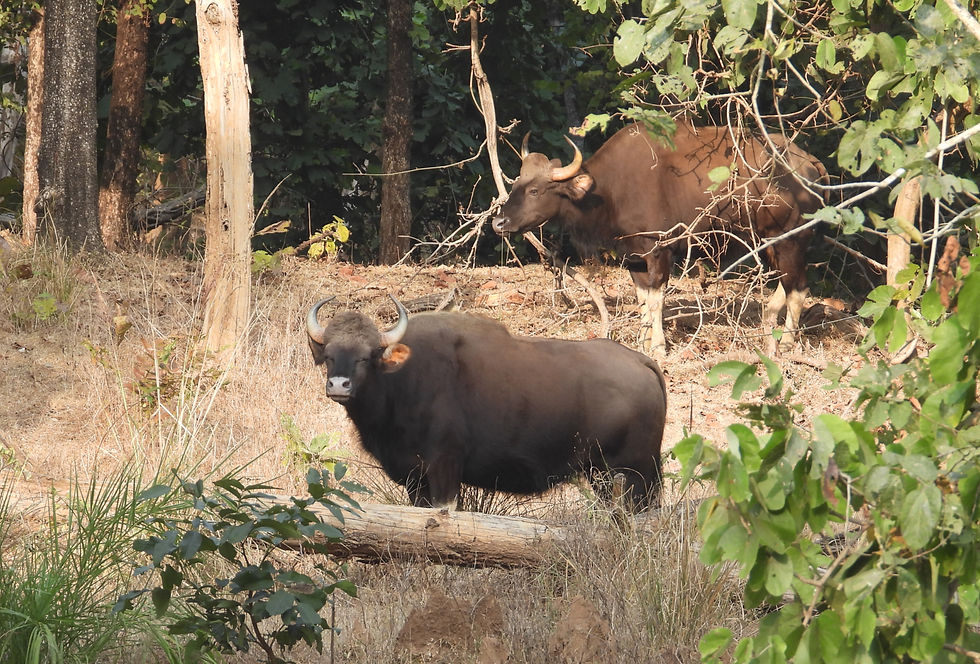
We saw a wild boar snuffling around close to the track and a herd of Gaur or Indian Bison on the edge of some thick forest. Gaurs are the largest and tallest of all wild cattle in the world. They were just munching away in the forest, under the trees.

We saw a Monitor Lizard basking on a rock. It was shedding its skin, so there were bits of skin peeling off. It was enormous! No wonder the birds start sending out alarm calls when they see one.

We saw some amazing birds today too. A really big Stork-billed kingfisher - it was over 30cm tall and very beautiful with a red beak, yellow front and iridescent blue back. It sat for ages on a branch watching for fish in the small river below.

We saw a Golden Oriole which is a beautiful yellow bird, and my favourite bird of the day a Wooly-necked Stork which was strutting around on the edge of the lake looking very grand!

Suddenly the guide told us to hang on tight and we started driving crazy fast! We didn’t really know what was going on, but eventually came to a stop. Hidden away into the bushes, at long last was a splash of orange! It was the last 15 minutes of our last safari and we spotted our allusive tiger! What a way to end what has been the most fantastic week!

We have had the best time. We have learnt so much about the forest, the animals and the people and we have been made to feel so welcome down here in the Pench Tiger Reserve.
We would like to thank Mandar Pingle and all his team at the Satpuda Foundation who have hosted us and organised the most incredible outings. They are a fantastic organisation who help both the people and the animals to live side by side in harmony. We were sad to leave and would love to return to beautiful central India again one day.
"At the Satpuda Foundation, our mission has always been to protect the wildlife and forests of the Satpuda landscape while empowering the local communities that coexist with them. By hosting John Dyer and Joanne Short, we are bringing a global spotlight to the delicate ecosystem of the Central Indian highlands. Art has the unique ability to transcend language and borders. By capturing the majesty of the Bengal Tiger and the vibrant culture of the Gond people, this initiative inspires children worldwide to value what we cannot afford to lose. By integrating art into our conservation model, we aim to foster a deeper emotional connection between urban youth, rural communities, and the natural world." Satpuda Foundation
Watch today’s final video from the dry tropical forest of Pench in central India, where we finally see a tiger!


Comments